

The front door is the part of a Perth home people see every day and think about least. It gets painted when the trim is painted. It gets replaced when it falls off the hinges. In between, most homeowners give it less consideration than the dishwasher.
That is a missed opportunity. The front door sits in the same envelope as every other window and door on the elevation. It conducts heat. It admits sunlight. It is the most exposed lock point on the house. A double glazed entry door upgrade is one of the highest-impact changes available to a Perth homeowner for the smallest scope of work, and yet most people only think about the front door after a break-in attempt or when the timber starts to rot.
This guide explains what makes a serious entry door upgrade in Perth: the structural choices (pivot, hinged, sidelights, transoms), the glass spec for the local climate, the lock that actually matters, and what the install day looks like.
Why the Front Door Is the Most Overlooked Upgrade in a Perth Home
Three reasons the front door is undersold.
First, marketing. Window companies talk about windows. Door companies that focus on garages and entry hardware talk about garages and hardware. The double glazed front door sits at the intersection and gets less mindshare.
Second, perceived cost. People anchor on the price of a standard replacement door rather than a purpose-built double glazed entry. A purpose-built double glazed thermally broken entry door with multi-point locking is a different product class.
Third, decisions feel low-stakes. The front door is one door, not 15 windows. The numbers feel small. Any improvement applies to the most visible point of the house, every day, for every visitor.
For homeowners weighing up a wider double glazing Perth refurbishment, the entry door is the part of the project where the most aesthetic, security and thermal gains compound in the smallest scope of work.
How a Double Glazed Entry Door Compares to a Standard Timber Door
The performance gap is real. A standard non-thermally-broken single glazed timber entry door has a Uw value (whole-door insulation rating) typically in the range of 3.0 to 5.0 W/m²K. A double glazed thermally broken aluminium entry door with low-e glass can achieve Uw values from approximately 1.8 to 2.8 W/m²K, depending on glass and frame spec.
In practical terms, the conducted heat through the standard timber door on a 40-degree Perth afternoon makes the interior face of the door warm to the touch. With a thermally broken aluminium double glazed door, the interior face stays close to room temperature. The frame is no longer a thermal bridge. The glass is no longer letting a wall’s worth of radiant solar load straight into the entry hall.
The security gap is also meaningful. A standard mortice deadbolt engages the door into the strike plate at one point at mid-height. A multi-point lock engages at three to five points around the leaf, distributing forced-entry load across the whole frame rather than concentrating it at a single strike plate.
Pivot Doors, Hinged Doors, Sidelights and Transom Panels
The four structural choices for a serious Perth entry door.
Hinged entry door (single leaf): the standard configuration. Hung on three or four hinges along one edge. Works at any size from a standard 820 mm door up to architectural 1200 mm wide pieces. Lowest installation complexity, highest compatibility with existing openings.
Pivot door: rotates on two pivot points (top and floor) set in from the door edge rather than at the hinge side. Part of the door swings in, part swings out simultaneously, which is the look people are usually after. Premium pivot hinge systems available in the AU market support doors up to 500 kg with no stated height restriction, with self-closing and soft-close options available. Common residential pivot doors range from 900 mm to 1200 mm wide by 2400 mm to 3000 mm high.
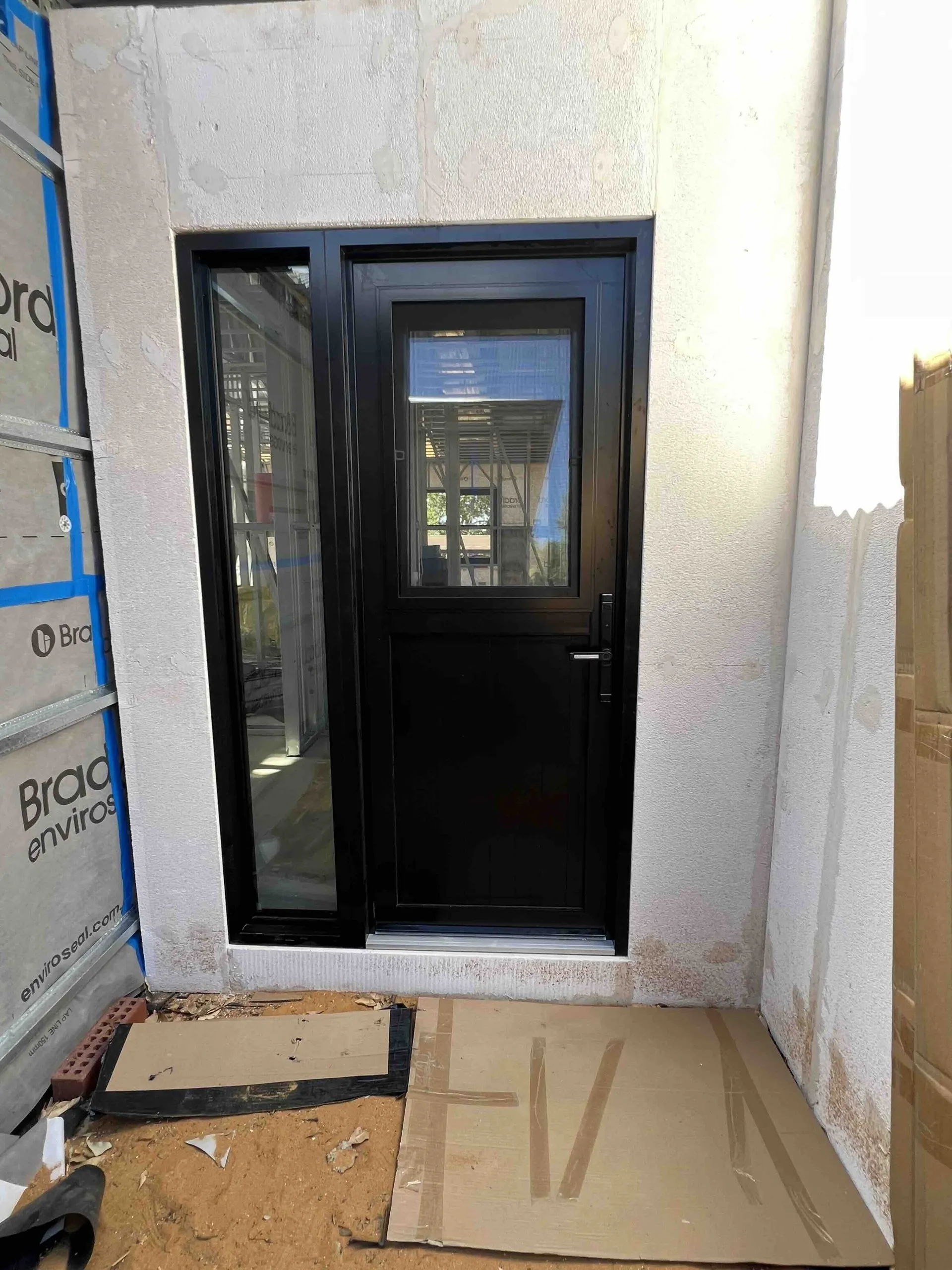
Sidelights: fixed glazed panels alongside the door within the same frame assembly. One side or both. They add width to the visual entrance composition and admit additional light without the structural complexity of additional operable leaves. Common widths are 300 to 600 mm per sidelight.
Transom panel: a fixed glazed panel above the door, separated by a horizontal transom rail. Used to maintain a full-height entry void while keeping the door to a manageable operational size. Common transom heights are 300 to 600 mm above the door head.
Sidelights and transoms are structurally non-load-bearing. They carry wind load and their own glass weight, with the surrounding frame handling the structural duty per AS 2047 for the site’s wind classification. The glass in each must independently comply with AS 1288. The Australian Glass and Window Association (AGWA) maintains a directory of certified suppliers and installers whose work must meet these standards.
Glass Choices for Perth Entry Doors: Clear, Frosted, Tinted, Low-E
Every glazed panel in an entry door must comply with AS 1288:2021 Grade A Safety Glass requirements. That means toughened or laminated. The choice between the two matters for security.
| Glass type | Property | Common entry door use |
|---|---|---|
| Clear toughened | Maximum light, AS 1288 compliant | Standard residential entry panels |
| Laminated clear | Holds in frame when broken, resists forced entry | Security-priority entries |
| Obscure or frosted toughened | Privacy without losing all light | Sidelights, side entries |
| Tinted or toned toughened | Solar control, reduced glare | West-facing entries |
| Low-e double-glazed (toughened) | Thermal performance | Thermally efficient upgrades |
| Decorative patterned | Aesthetic with partial privacy | Feature sidelights |
The Perth-specific decision is the same as for any other window: solar heat gain coefficient (SHGC) matters more than U-value for west and unshaded north-facing entries. A solar-control low-e double glazed unit in the door and sidelights drops SHGC to 0.20 to 0.40, well below the 0.70+ of clear glass. Our guide to U-values, SHGC and window energy ratings in WA covers what the numbers mean.
For an entry with security as the lead concern, the right answer is laminated glass on the outer pane of the IGU. When the outer pane is broken, the laminate holds the glass in the frame and denies an intruder a clean entry. Toughened glass shatters into small cubes and falls away completely, potentially opening the opening immediately. The Penot Double Glazing windows range covers both options across all frame types.
Multi-Point Locks and the Security Difference
The multi-point lock is what makes a serious entry door serious. Multi-point mortice locks are the AU residential standard for security-grade external doors. Lifting the lever engages locking rods at the top and bottom of the door into the frame; turning the key engages a throw bolt securing the rods and the latch.
Configuration matters:
- 3-point systems engage at the top, mid-height, and bottom. Standard for most Australian aluminium external doors.
- 4-point systems add a fourth engagement point. The most common premium specification.
- 5-point systems add a fifth, with two intermediate bolts and a central deadbolt. More common in European-specification entries.
Beyond the security benefit, multi-point locks improve the door’s seal performance. Four or five engagement points compress the perimeter seals more evenly than a single mid-height deadbolt, which reduces drafts and rattles.
Hardware finishes match the door spec: powder-coat black is popular currently, satin chrome and brass remain timeless, and matte black with internal bronze hardware suits contemporary entries.
Aluminium and Timber: Choosing the Right Material in Perth
Thermally broken aluminium dominates the Perth premium entry door market. The polyamide thermal break interrupts conduction through the frame from outside to inside. Frame finish options include the full Dulux powder-coat range and woodgrain foil for a timber look. Maintenance is minimal: a wipe down twice a year.
Timber is available through premium European-style timber and wood-alu suppliers and a small number of bespoke joinery suppliers. Solid timber has natural insulation properties and accepts double glazed IGUs. The cost is maintenance: repainting or oiling every three to seven years depending on exposure. Wood-alu hybrids put timber on the inside face (where the warmth shows) and aluminium on the outside (where the weather hits), which manages the maintenance problem.
Composite and fibreglass entry doors are rare in the Perth market. If a US-market entry door is being considered, factor in the lack of local supply chain for replacement parts.
How to Match a New Entry Door to Your Home’s Existing Style
Three matching principles that hold up across most Perth architectural eras.
Sightline. A Federation cottage with timber-look detailing is rarely improved by a wide-sightline industrial aluminium entry. Choose a slim architectural aluminium system (45 to 65 mm sightlines) or a wood-alu hybrid. A 1970s brick-veneer entry takes a standard 65 to 80 mm sightline aluminium frame in stride. A contemporary build can carry the wider sightlines of a heavier-spec thermally broken commercial door system.
Glass proportion. Heritage and interwar entries traditionally use less glass: a panelled door with a small obscure light, plus a transom. Mid-century entries take more glass, often a full-height vertical light strip. Contemporary entries lean toward maximum glass, often with sidelights both sides and a full glazed leaf.
Colour and finish. Match the dominant trim colour on the elevation, or contrast it deliberately. Black powder-coat reads as contemporary; charcoal or bronze reads as transitional; cream or off-white maintains heritage character; woodgrain foil on aluminium reads as warm.
Heritage overlay properties have a fourth consideration: council approval. Most Perth councils with significant heritage areas (Town of Cottesloe, Town of Claremont, City of Subiaco, City of Fremantle, City of Vincent, City of Nedlands) require a development application for changes to street-facing elevations. The application process is straightforward when the new door is sensitively specified, but worth confirming early.
Typical Costs for Double Glazed Entry Doors in Perth
2026 indicative ranges. Confirm with a quote.
| Spec | Supply only | Supply and install |
|---|---|---|
| Standard hinged thermally broken aluminium, double glazed, multi-point lock | $4,000 to $6,500 | $5,500 to $9,000 |
| Premium hinged with sidelights, low-e glass | $6,500 to $10,000 | $8,500 to $13,500 |
| Pivot door with sidelights and transom | $9,000 to $18,000+ | $12,000 to $25,000+ |
| Wood-alu hybrid | $8,000 to $16,000+ | $11,000 to $22,000+ |
The Penot Double Glazing cost guide for Perth covers what each spec change does to the bottom line. Glass upgrades add $200 to $800 per panel depending on the option. Frame finish upgrades (custom powder-coat colour, woodgrain foil) add $200 to $500.
What the Installation Day Looks Like
A single entry door install is typically a day for two installers, occasionally two days if the existing opening needs structural modification. Stages: existing door removal, opening preparation, threshold dressing, new frame installation set plumb and level, head and sill flashings dressed, door hung and adjusted, hardware set and tested, perimeter seals checked, internal trim and architrave reset, debris removed. The home stays secure overnight if there is any spillover, with temporary closure detail agreed at the start of the day.
Where Penot Double Glazing Fits
Penot Double Glazing is a full AGWA member based at 92 Beechboro Rd S, Bayswater WA 6053. Entry doors are supplied as part of the standard double glazed doors range, with options for hinged, pivot (subject to engineering review), sidelights, transom panels, slim architectural sightlines, thermally broken frames, solar-control low-e and laminated glass, and multi-point hardware as the standard WA specification. Penot Double Glazing offers a 10-year warranty on frames. Ask about IGU seal, hardware and installation warranty terms at the quote stage.
If you are weighing up an entry door upgrade and want a quote that reflects the elevation rather than a generic price, book a free in-home assessment, call 1300 121 603, or visit the Bayswater showroom at 92 Beechboro Rd S. Visit the Penot Double Glazing home page for an overview of windows, doors and the full product range.
How Much Does a Double Glazed Front Door Cost in Perth?
A double glazed thermally broken aluminium entry door in Perth typically sits in the range of $4,000 to $9,000 supply only, depending on size, glass spec, hardware and finish. Pivot doors with sidelights and a transom panel run higher, often $9,000 to $18,000+ for premium architectural specifications. Supply and install adds approximately 30 to 55 per cent over supply only.
Are Double Glazed Front Doors More Secure than Standard Doors?
Yes. A multi-point lock engages the door into the frame at 3 to 5 points compared to a single-deadbolt door that engages only at mid-height. Multi-point systems distribute forced-entry load across the whole frame rather than a single strike plate. Laminated outer glass in the panel resists forced entry because the glass stays bonded to its PVB interlayer when broken instead of falling out of the frame. For a deeper read on the security side, see our security guide for double glazed windows in Perth.
Can You Put a Double Glazed Front Door in a Heritage Perth Home?
Yes, with some caveats. The frame profile, sightline and finish need to match the heritage character of the home, which usually points to a slim architectural aluminium system or a timber and wood-alu hybrid system. Heritage overlay properties may also need council development application approval before the existing door is replaced. Penot Double Glazing’s consultation covers what the council and the look both require.
What’s the Energy Benefit of Upgrading a Perth Front Door?
A standard single glazed timber entry door has a Uw value of around 3.0 to 5.0 W/m²K. A double glazed thermally broken aluminium entry door with low-e glass typically achieves Uw of 1.8 to 2.8 W/m²K. In a hot Perth summer that means measurably less conducted heat through the door and far less radiant heat through the glass when low-e and a low SHGC are specified for west-facing entries.