

Two homeowners ask for the same thing: an indoor-outdoor opening of around 3600 to 4800 mm. Two different builders come back with two different quotes. One quotes a bifold. The other quotes a lift and slide. The numbers are different. The visuals look similar. The salesperson on each side says theirs is best for Perth.
This guide is the direct comparison. How each system actually works, what each does well, where each ages badly, and how to choose for a Perth opening rather than for a generic Australian one.
How Each System Actually Works
A bifold door consists of multiple panels hinged together that fold like a concertina. When open, the panels stack to one or both sides of the opening. When closed, they sit flat in the frame line and lock together. The driven panel runs on a track at the top or bottom (or both) and the panels are guided by rollers. The mechanism is consistent across AU bifold systems: panels fold and stack via inter-panel hinges plus track-guided rollers.
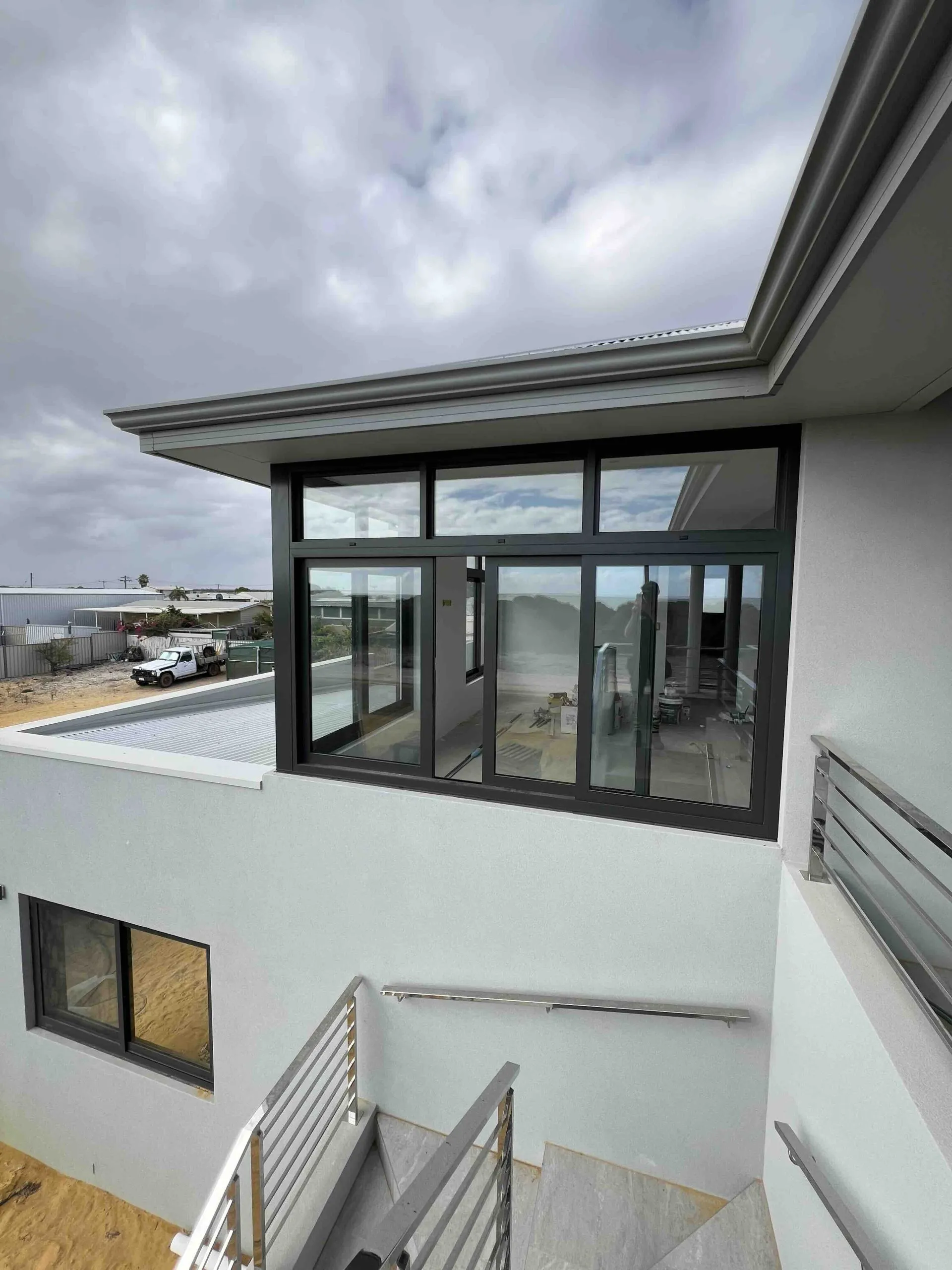
A lift and slide door consists of large fixed and operable panels that slide horizontally on a track. The defining mechanism is in the hardware: when the handle is turned, it lifts the panel off its seals via a cam-and-lever system, freeing the panel to glide on heavy-duty rollers. When the handle is returned, the panel drops back onto the seals and compresses them. AS 2047 tested lift and slide systems are available in the AU market. The mechanism decouples the sliding action from the sealing action, which is what makes the seal performance fundamentally different from a standard sliding door or a bifold.
A standard sliding door (without lift mechanism) is the third option. Cheaper, lighter, simpler. It seals less well than a lift and slide because the seal is in compression all the time and dragged along by the panel.
Weight and Ease of Use: Which System Ages Better in Perth
A bifold has multiple panels with hinges between every pair. Five panels means four hinge pairs, plus the track rollers. Every hinge and roller is a mechanical wear point. After 10 to 15 years of daily use, particularly in Perth’s late-summer dust, hinges can stiffen, rollers can develop flat spots, and panel alignment can drift. Commercial-spec AU bifolds typically specify a maximum panel weight of 100 kg for this reason: heavier than that, and the cumulative load on the hinges becomes a problem.
A lift and slide has two rollers and a single track per operable panel. The handle mechanism is mechanically simple: a cam-and-lever lift system. Less to go wrong. The trade-off is that each panel is heavier (a lift-and-slide panel typically weighs 50 to 200 kg depending on size and glass spec), and lifting and sliding the panel takes deliberate effort. The mechanism makes that effort easier through mechanical advantage, but a lift and slide is not a door you operate one-handed while carrying groceries.
For Perth’s heat and dust, the dust matters more than the heat for these systems. Sand and grit work into bifold track and hinge points more aggressively than they work into the simpler lift-and-slide track. After two summers, the difference in operation between a worn bifold and a well-maintained lift and slide can be noticeable.
How Each Seals Against Dust, Heat and Rain
The seal mechanism is the central technical difference.
Bifold seals. Perimeter brush and pile seals run along the frame and between panels. The seal is in compression all the time, but the compression load is moderate. Dust ingress is possible at the inter-panel joints, particularly after years of use. Water penetration resistance ratings under AS 2047 reflect this: AU bifold systems test to 150 Pa for residential and up to 450 Pa for commercial specification. Bifolds are reasonable in normal conditions and rated to handle moderate driving rain, but they are not the choice for an elevation taking the full brunt of a Perth winter southwesterly.
Lift and slide seals. A heavy compression seal runs around the panel perimeter. The handle mechanism lifts the panel off this seal for operation, then drops it back to fully compress the seal when closed. The compression load is significantly higher than on a bifold, which is what gives premium AS 2047 tested lift and slide systems their 300 Pa water resistance rating with the standard configuration, and higher with upgrades. The seal life is also longer because the seal is not dragged along by the panel during operation.
For Perth specifically, the seal difference shows up in two ways. The summer afternoon dust through an open bifold seal at the meeting point is a real thing in homes near construction sites or main roads. And winter driving rain on a southwest-facing alfresco bifold can find its way in at the threshold, particularly after a few years of seal wear. A lift and slide is the better answer in both cases.
Maximum Span Widths
| System | Max panel (H x W) | Max overall opening width |
|---|---|---|
| AS 2047 tested lift and slide (premium AU) | 3300 mm x 2500 mm | ~7400 mm with multi-panel configuration |
| Commercial-spec bifold (AU) | 3000 mm x 1000 mm | 6400 mm overall, 450 Pa water resistance |
| Residential bifold (AU) | Varies by fabricator | Typically 6000 mm |
For openings up to 4000 mm, both systems handle the span. For openings between 4000 and 6400 mm, both still work but lift and slide tends to look cleaner because fewer larger panels stack better than many smaller ones. For openings above 6400 mm, lift and slide is usually the only option in residential aluminium without going to a commercial-spec product.
Long-Term Maintenance Requirements
Bifold maintenance schedule:
- Track cleaning quarterly in dusty environments, twice a year otherwise
- Hinge inspection annually, lubrication as needed
- Roller adjustment every 2 to 3 years for level
- Seal inspection annually, replacement at 8 to 12 years
- Lock mechanism service every 5 years
Lift and slide maintenance schedule:
- Track cleaning quarterly in dusty environments, twice a year otherwise
- Roller inspection every 2 to 3 years
- Cam-and-lever mechanism inspection every 3 to 5 years, lubrication if recommended by manufacturer
- Seal inspection annually, replacement at 12 to 15 years (longer than bifold because seal wear is lower)
- Lock mechanism service every 5 years
The lift and slide is genuinely lower maintenance over a 20-year life because the seal lifespan is longer and there are fewer mechanical wear points. The bifold maintenance schedule is not unreasonable but it does compound: five panels means five sets of hinges, five inter-panel seal interfaces.
Which System Suits Which Situation
Choose a bifold for:
- Indoor-outdoor connection where full-width unobstructed opening matters more than premium seal performance
- Openings between 2400 and 6000 mm where the budget is closer to entry-level premium
- Climates and elevations not exposed to heavy driving rain or constant dust
- Architectural intent that wants the panels to stack visibly to one side
Choose a lift and slide for:
- Indoor-outdoor connection where premium seal and acoustic performance matter
- Exposed elevations: west-facing alfresco, southwest-facing courtyard, anywhere taking driving rain
- Openings above 6000 mm where bifold becomes structurally and visually heavy
- Architectural intent that wants large, flat planes of glass when closed
- Long-term thinking: the higher purchase cost amortises across a longer seal life and lower maintenance load
For a step up in scale or a deeper thermal analysis of large openings on west-facing rooms, see our guide to large glass openings in Perth homes. The seal performance comparison also matters for sliding doors specifically, covered in our double glazed sliding doors Perth cost guide. The Penot Double Glazing doors range covers both lift and slide and bifold so a direct on-site comparison can run at the same quote stage.
Price Difference Between Lift and Slide and Bifold
2026 indicative supply only ranges for a 3600 mm opening, double glazed thermally broken aluminium:
| System | Standard spec | Premium spec |
|---|---|---|
| 3-panel bifold | $5,000 to $7,500 | $7,000 to $9,500 |
| 3-panel lift and slide | $7,000 to $10,000 | $9,500 to $13,000 |
Supply and install adds 30 to 55 per cent. Glass upgrades (low-e, acoustic laminated) add $300 to $1,000 per panel depending on the option. Soft-close systems on the lift and slide add a further premium.
The 20 to 40 per cent lift-and-slide premium reflects the heavier hardware, the engineered seal compression mechanism, the larger frame profile required to carry the panel weight, and the more substantial track and roller assembly. The Penot Double Glazing cost guide for Perth covers what each option does to the bottom line.
For a related comparison covering French doors vs bifold, our double glazed French doors buyer’s guide covers that decision in detail.
Comparison Table
| Attribute | Bifold | Lift and Slide |
|---|---|---|
| Mechanism | Panels fold and stack via hinges + track rollers | Heavy panels glide on track; handle lifts panel off compression seal |
| Max panel weight (AU) | ~100 kg (commercial-spec AU bifold) | ~200+ kg (premium AU lift and slide) |
| Max opening width | ~6400 mm | ~7400 mm multi-panel |
| AS 2047 water resistance | 150 to 450 Pa | 300 Pa standard, higher with upgrades |
| Seal compression | Moderate (perimeter brush/pile) | High (engineered seal lift) |
| Mechanical wear points | Many (hinges, rollers, panels) | Few (rollers, cam-and-lever) |
| Maintenance load | Higher | Lower |
| Visual when open | Panels stack visibly | Panels slide behind a fixed leaf |
| Visual when closed | Slim frame lines between panels | Larger frame lines, big flat planes of glass |
| Cost (3600 mm, double glazed) | $5,000 to $9,500 supply only | $7,000 to $13,000 supply only |
| Best for | Full-width opening, lower budget | Premium seal, exposed elevations, long-term thinking |
Questions to Ask Before Committing
- What’s the AS 2047 water resistance rating on the specific product being quoted?
- What’s the maximum panel weight the system is certified for, and what does my panel actually weigh with the glass I want?
- How many panels do I want to open in normal use, and how often will I open the full width?
- What does the seal replacement cost in 10 years’ time, and how disruptive is the install?
- Does the supplier work direct on warranty claims, or through a third party?
- Is the threshold flush or upstand? Flush thresholds at exterior doors require careful drainage design in Perth’s heavy rain events.
Where Penot Double Glazing Fits
Penot Double Glazing is a full AGWA member based at 92 Beechboro Rd S, Bayswater WA 6053. Both lift and slide and bifold systems are supplied as part of the standard double glazed doors range, with options for slim architectural sightlines, thermally broken frames, solar-control low-e and acoustic laminated glass, and the hardware specifications that lead the WA market. Penot Double Glazing offers a 10-year warranty on frames. Ask about IGU seal, hardware and installation warranty terms at the quote stage.
Every quote specifies the AS 2047 water resistance rating, the IGU configuration, the SHGC value by orientation and the hardware specification. The decision between lift and slide and bifold is best made on site with the actual opening, the actual orientation and the actual exposure in mind. Compare options across the wider double glazing Perth range, book a free in-home assessment, call 1300 121 603, or visit the Bayswater showroom at 92 Beechboro Rd S.
Is Lift and Slide Better than Bifold for Perth Homes?
Lift and slide seals better against dust, rain and heat because the mechanism compresses the seal when the door is closed. Bifolds rely on perimeter brush and pile seals that are less tightly compressed. For exposed elevations and homes in Perth’s dust and summer extremes, lift and slide ages better. Bifold remains the right choice when full-width unobstructed opening matters more than seal performance.
How Wide Can a Lift and Slide Door Go?
AS 2047 tested lift and slide systems are available that handle panels up to 3300 mm high by 2500 mm wide. Multi-panel configurations can run to 7400 mm overall width. Bifold systems in the AU market reach 6400 mm wide overall at commercial specification.
What Does a Lift and Slide Door Cost in Perth Compared to a Bifold?
For a comparable 3600 mm opening, a lift and slide is typically 20 to 40 per cent more than a quality bifold, all else equal. The premium reflects the heavier hardware, the engineered seal compression mechanism and the larger frame profile. 2026 indicative supply only ranges: bifold $5,000 to $9,000, lift and slide $7,000 to $13,000. Confirm with a quote.
How Much Maintenance Does a Lift and Slide Need?
Less than a bifold, in most installs. A lift and slide has two rollers and a single track. A bifold has hinges between every panel, plus rollers and a track. The lift mechanism lifts the panel off the seal during operation, so seal wear is lower. Both systems require track cleaning, but the lift and slide has fewer moving parts to lubricate.